US Department of Defense Collaborates with AI Companies
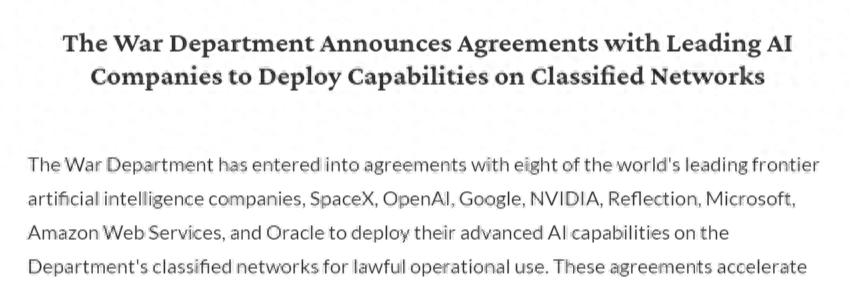
According to the US Department of Defense, it has reached agreements with several leading frontier AI companies, allowing them to deploy advanced AI technologies on the Department’s secure networks for legitimate combat purposes. These companies include SpaceX, OpenAI, Google, NVIDIA, Reflection, Microsoft, and Amazon Web Services (AWS).
The Department’s statement claims that these agreements will accelerate the transformation of the US military into an AI-prioritized combat force and enhance its decision-making capabilities across all operational domains.
Experts: AI is Profoundly Changing Modern Warfare
In today’s rapidly developing AI landscape, what changes will the application of AI bring to the military? Xie Hui, an assistant researcher at the Institute of World Peace and Security Studies of the China Institute of International Studies, stated in an interview with Global Information that AI is not simply adding a new weapon but is profoundly changing the organizational forms, command modes, and operational methods of modern warfare.
Recent regional conflicts show that military applications of AI can be broadly categorized into two directions: one is for military support systems, such as quickly processing satellite, drone, radar, and communication data to help armies grasp battlefield situations faster, filter targets, and formulate plans. The other is for weapon systems, such as autonomous target recognition, route planning, coordinated operations, and fire control assistance, which bring deep changes.
In the past, military power was largely about comparing platform firepower and troop scale; now, it increasingly shifts towards competition in data algorithms, computing power, and system coordination capabilities. AI can improve intelligence processing efficiency and strike accuracy, reduce personnel exposure to high-risk battlefields, and potentially decrease equipment and ammunition losses. However, it also compresses decision-making time, accelerates the pace of war, and shortens the chain from detection and judgment to strike.
US Pushes for Deep AI Integration in Military, Heightening Global Concerns
Multiple US media outlets reported that former Iranian Supreme Leader Khamenei was killed in an airstrike on February 28, facilitated by US reliance on AI technology and cyber espionage methods. On the same day, an elementary school in southern Iran was attacked, resulting in the deaths of over 160 students. Journalist Tyler Austin Harper from The Atlantic characterized this incident as a civilian casualty caused by an AI technology application’s “target recognition error.”

Xie Hui believes that the US’s push for major tech companies to deeply enter military systems will further blur the boundaries between civilian technology and military operations, exacerbating international concerns about the uncontrolled militarization of AI.
The accelerated use of AI in military operations exposes the real concerns of AI militarization. Some technologies that have not been fully validated, lack transparency, and have unclear responsibility boundaries are being rapidly applied in real combat scenarios, directly affecting key aspects such as target recognition, operational decision-making, and fire strikes.
While AI can indeed enhance intelligence analysis, target recognition, and operational planning efficiency, it does not guarantee accuracy in judgment. The battlefield environment is highly complex; data may be outdated, images may be unclear, communication may be disrupted, and models themselves may have biases. If AI is misused in target recognition and strike processes, it could lead to severe civilian casualties with irreparable consequences. Moreover, there is a growing concern that human roles in war decision-making may be diminished; AI can provide analytical support, but it cannot replace humans in making life-and-death decisions.
Experts: AI Should Serve Peace, Not Make War More Efficient
The misuse of AI technology in warfare raises increasingly prominent ethical risks and security hazards. UN Secretary-General Antonio Guterres has warned that humanity’s fate should not be left to algorithms. So how can we regulate and constrain the development of AI?
Xie Hui believes that to ensure AI truly serves peace, it should not make wars more efficient but rather reduce misjudgments and lower the risk of conflict escalation. AI should be more focused on peace objectives such as peacekeeping, mine clearance, humanitarian rescue, disaster warning, and crisis management.
-
Human control must be upheld, especially in decisions involving target selection, fire strikes, and life-and-death judgments. The decision-making power should not be entirely entrusted to machines; AI can assist in analysis and provide suggestions, but the ultimate decision to use force must be made by humans, who should also bear responsibility.
-
Technological safety and reliability must be ensured. Military environments are highly complex; data may be incomplete, communication may be disrupted, and models may produce misjudgments. Therefore, any military AI system should undergo strict testing and risk assessment before being deployed. Systems closer to the end of the kill chain must be used cautiously, retaining human intervention and emergency stop mechanisms.
-
Clear responsibility boundaries must be established. The use of AI in military operations should not lead to unclear accountability. There should be clear divisions of responsibility among developers, deployers, commanders, and users. In the event of misfires or system failures, the causes must be traceable, responsibility identified, and corrections made promptly.
-
International rule-building must be strengthened. The rapid development of AI militarization applications is outpacing the establishment of relevant international norms. The international community should use the UN as the main channel to promote consensus among major military powers, countries leading in AI technology, and developing countries on issues such as autonomous weapons, human-machine control, civilian protection, and accountability.
Comments
Discussion is powered by Giscus (GitHub Discussions). Add
repo,repoID,category, andcategoryIDunder[params.comments.giscus]inhugo.tomlusing the values from the Giscus setup tool.