In the rapid evolution of artificial intelligence (AI) technology, a fierce competition over who will dominate the next generation of enterprise software is quietly unfolding.
Recently, AI assistant Claude, launched by the American AI startup Anthropic, has caused significant market turbulence with its powerful programming capabilities, industry plugin ecosystem, and deep integration into enterprise workflows. This has not only led to a decline in tech stocks but has also sparked widespread discussion about the future of the SaaS (Software as a Service) business model.
User Enthusiasm, Market Anxiety
Anthropic recently launched its flagship AI model, Claude Opus 4.6, which surpasses its predecessor in coding capabilities. Moreover, Opus 4.6 can apply its enhanced features to a range of everyday tasks: running financial analyses, conducting research, and using and creating documents, spreadsheets, and presentations. In a Cowork environment, Claude can autonomously execute multiple tasks. In Claude Code, users can also form agent teams to collaborate on tasks.
Two days later, Anthropic introduced Claude Opus 4.6’s “Fast mode,” which boosts speed by 2.5 times.
Boris Cherny, head of Claude Code, stated that the team had been using the tool for development over the past few weeks, calling it a significant breakthrough.
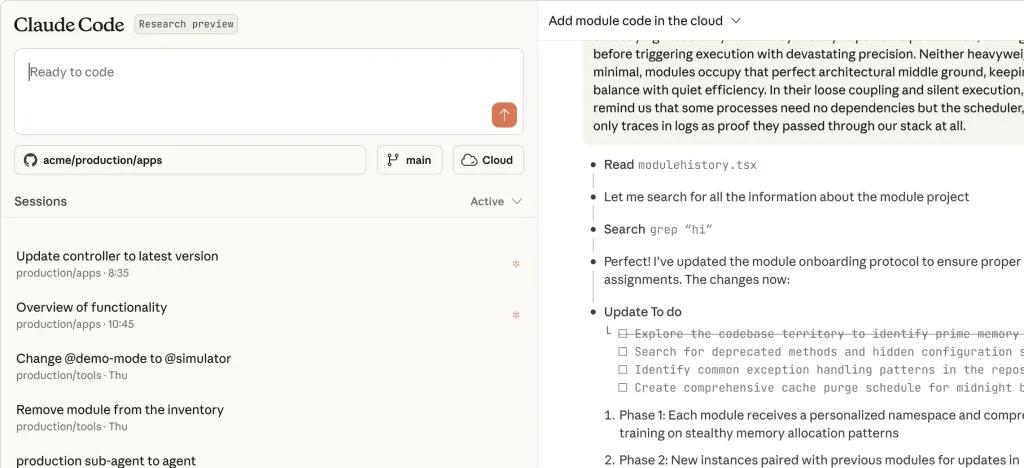
Anthropic previewed Claude Code in February 2025, publicly launched it in May, and released Claude Sonnet 4.5 and Claude Code 2.0 in September. The latter version moved beyond command-line limitations, allowing users to save states while AI automatically modifies code, and opened up the underlying framework for developers to customize agents. In January 2026, Anthropic further lowered the barriers by including Claude Code access in its Team plan.
These initiatives rapidly expanded the user base. Claude Code has not only gained popularity among programmers but has also attracted many non-technical users. Social media is filled with stories from individuals who have never learned programming, sharing their experiences of successfully developing their first applications using Claude Code for tasks like health data analysis and expense reporting.
Based on this trend, Anthropic quickly incubated a derivative product, Claude Cowork. According to Cherny, the entire Cowork project went from concept to launch in about 10 days, leveraging Claude Code’s capabilities.
The continuous capability upgrades of Anthropic’s models have led to declines in the stock prices of software companies. Market anxiety has spread rapidly—if businesses can use AI to autonomously build customized tools, is there still a need to purchase standardized SaaS products?
Market research firm Analytics Insight notes that an increasing number of developers are embedding models like Claude directly into their products, which may weaken the existing advantages and user stickiness of traditional SaaS vendors in data analysis and research workflows.
Thomas Shipp, head of stock research at LPL Financial, remarked, “People will wonder, if AI can significantly reduce the time needed to internally develop these systems, why should I still pay for off-the-shelf software? Moreover, with the release of products like Cowork—an application that can access file reading and editing permissions—tech users now have the capability to replace existing workflows.”
Jensen Huang Supports “AI + Software”
In fact, AI’s involvement in the software field has already begun. OpenAI’s Codex, launched in 2021, demonstrated the ability to generate executable code through natural language, giving rise to a series of programming assistance tools. However, at that time, AI played a more auxiliary role, helping developers complete repetitive coding tasks faster rather than reconstructing entire business processes.
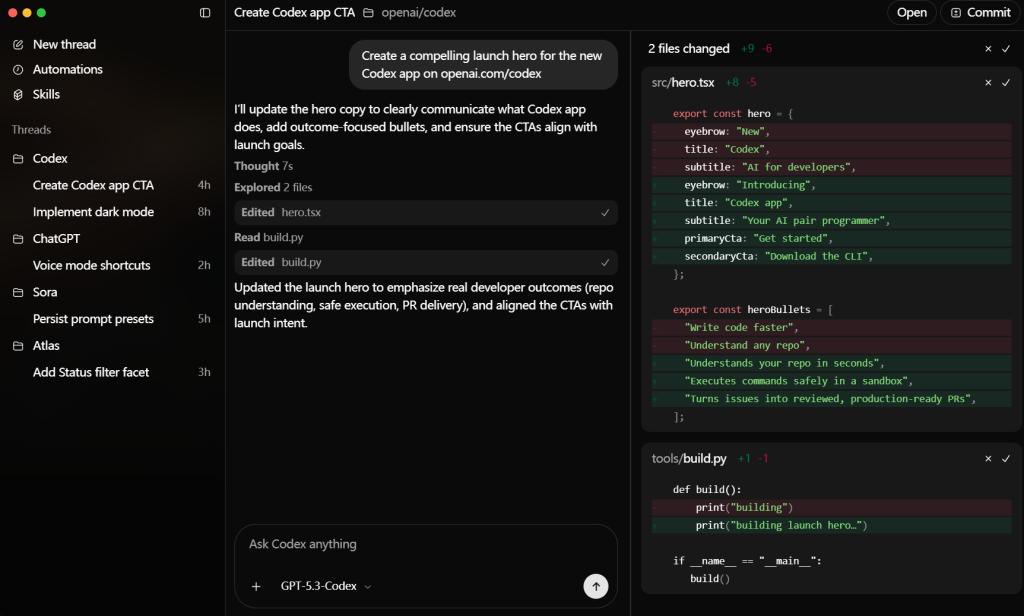
On the same day Anthropic released Claude Opus 4.6, OpenAI also officially launched GPT-5.3-Codex. Codex can automatically run without prompts, handling tasks like issue routing, alert monitoring, and CI/CD, allowing agents to work in parallel across multiple projects, reducing development cycles from weeks to days. OpenAI also launched a dedicated Codex App, equipped with a multi-agent command center and localized integration.
Today’s AI tools demonstrate more systematic capabilities.
In response to market anxiety, NVIDIA CEO Jensen Huang has publicly expressed differing views multiple times. At an industry forum on February 4, he stated, “Some believe that software tools are declining and will be replaced by AI… This is the most illogical thing in the world, and time will prove this.”
He further explained: software is a tool, and AI will use these tools rather than reinvent them. “We are welcoming the biggest opportunity in software history. For the first time, software is no longer just a tool. For example, Excel is a tool; now software starts using tools—these AIs will use Excel. Therefore, I believe this new era of software contains incredibly amazing opportunities.”
Market research firm Aurelion Research’s analysts also noted that the recent sell-off was “emotion-driven,” and as businesses gradually see measurable returns from AI, this sentiment may “normalize.”
Nick Dempsey, head of media equity research at Barclays Bank, pointed out that he remains skeptical about whether general AI models can truly become viable alternatives with industry expertise.
Li Bojie, co-founder and chief scientist of Pine AI, stated in an interview that Claude’s recent release reflects that AI’s code production capabilities are becoming increasingly strong. However, this does not mean that AI agents can directly replace SaaS; rather, it reveals a trend: as AI capabilities continue to upgrade, the market space for traditional SaaS industries will inevitably be compressed.
“In fact, AI frontier workers have already noticed this phenomenon, while the market’s response has been relatively slow,” Li said. “This means that only those software companies that actively use AI to enhance their capabilities and fully leverage data advantages will survive better in the future.”
Where is the Future of Software?
So, will agents fundamentally disrupt the underlying logic of the software industry?
Tan Jian, an associate professor at the School of Digital Media and Design Arts at Beijing University of Posts and Telecommunications, believes that rather than saying agents are challenging the product logic of traditional SaaS, it is more of a “value return.” In his view, agents are pulling SaaS back from being a “functional tool” to a “service commitment,” rewriting the way software interacts with humans and its pricing model.
Tan pointed out that the core positioning of Claude Coworker is not to provide more functions but to deliver “directly usable results.” Its plugins essentially package job SOPs (Standard Operating Procedures), tool connections, and trigger commands into reusable capabilities, which is not fundamentally different from the traditional SaaS goal of pursuing standardized outputs: “In the past, employees pressed buttons and learned systems; now users define goals and let the system complete them.”
In Tan’s view, agents will not “eat away” the core market of traditional SaaS in the short term; the key lies not in process capabilities but in the “trust and accountability chain.” Once an agent misoperates, the impact often exceeds that of a human, yet accountability is difficult to enforce quickly. If similar cases arise, it will significantly raise enterprises’ demands for “auditable, reversible, and accountable” requirements.
Looking ahead to the future of the software industry, Tan believes that as agents become more prevalent, software pricing may shift from per-head charges to result-based payments, and the industry will differentiate into “tool-type SaaS replaced by front-end agents” and service-type SaaS evolving into “value result platforms,” with the latter being able to stay at the table in the AI era.
Li Bojie believes that the future competitive barriers in the software industry will show differentiation: on the B2B (business) side, the core will be data accumulation and domain knowledge; on the B2C (consumer) side, it will still need to return to traditional internet strategies, where product capabilities and operational abilities will profoundly impact competitiveness.
Claude’s rise is less about a “shock” to software and more about an opportunity to force the software industry to upgrade. AI has not negated the value of software but has redefined “how software should be used.” As Huang said, we are entering a new era of “AI using software,” where humans set goals, and AI manages tools, with traditional software becoming the “infrastructure” called upon by AI.
In this transformation, no one is destined to be eliminated; only those who fail to evolve in time will be left behind. For businesses, the key may not be whether to adopt Claude or Codex, but whether they can leverage AI to unlock their own value. For the software industry, the real challenge is just beginning: how to continue being an indispensable “tool provider” in the intelligent era.
Comments
Discussion is powered by Giscus (GitHub Discussions). Add
repo,repoID,category, andcategoryIDunder[params.comments.giscus]inhugo.tomlusing the values from the Giscus setup tool.